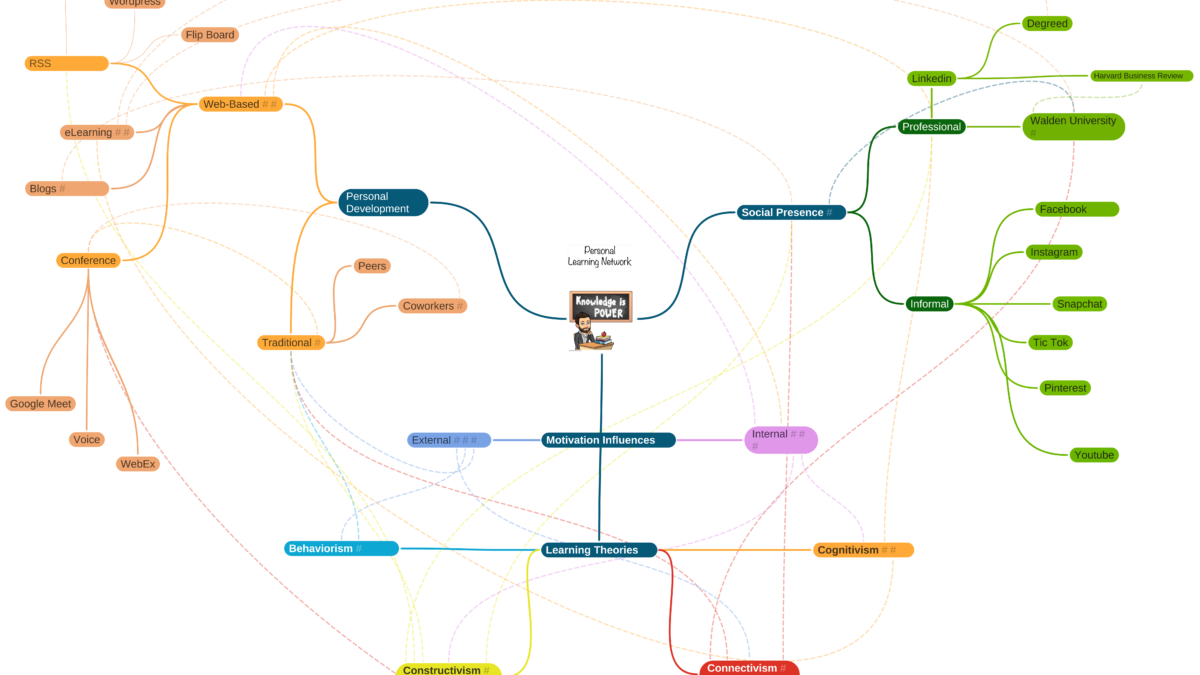
In high school, the time it took to complete a course was a drawn-out perception. Motivation, extrinsically influenced, relies on a facilitator’s role in direct information processing (Cercone, 2008). As a student, I was more internally motivated to get to the next summer/holiday break. The days went by slow, and the ability to cognitively process knowledge limited by forced engagement resulting in generalized storage of the experience. As we age, the perception of time shortens. “Where has all the time gone” a frequently used saying that directly correlates with this belief. As an adult learner, the processing time for knowledge is shortened; As we have little “time” to commit to the learning process and ability to infer internal and external experiences to reduce overwriting previous LTE storage (Cercone, 2008). Knowledge facilitation evolves to become quick, direct factual information that requires self-direction (Conlan, Grabowski & Smith, 2003). The rise of technology allowed advancements in multi-media facilitation in a virtual environment built to expand one’s learning network.
Personal Learning Networks (PLN), challenge learning interpretations by engaging in a social presence, both physical and virtual. Connectivism, theorized by George Siemens in 2005, hypothesizes continuous learning using personal informational structures is most effective when looking beyond the traditional settings to support an advanced level of understanding (Andriotis, 2017). Developing a network of learning requires a PLN comprising three elements: connection building, connection maintenance, and connection activation (Gutierrez, 2016). As these three components express similarities in personal learning environments (PLE), PLN is rooted in self-directed learners (Gutierrez, 2016). PLNs focus on adding new people or resources, keeping resources fresh, and activating these connections in the relevant context (Gutierrez, 2016). As demonstrated in many different attempts to solve how learning occurs, a PLN is only a portion of one’s PLE. One’s PLE can be comprised of like-minded peers. However, a PLN requires unique constructivist views that challenge fundamental understandings using active engagement through technological advancements in social and educational platforms (Gutierrez, 2016). In summary, PLNs are self-constructed extensions of one’s PLE (Andriotis, 2017).
The time constraints and changing demands, professional and personal, on an adult learner help define the need for a PLN, especially in the workplace. To address sustainability, and relevant both an employer and employee must develop a learning-centric culture starting with one-on-one interaction. As job expectations advance form generalized stimulus-response, cognitive processing is required to remain at the forefront of learning initiatives. The need for “expert” learning is crucial to stay innovative. PLNs answer concerns with implicating traditional learning approaches in adult learning. Formal education can negatively impact the ability to juggle “life,” the time spent constructing interpretation, and financial obligations (Andriotis, 2017).
When reflecting on your PLN, you need to understand the benefits. PLNs are self-directed/self-constructed. They offer the learners a choice in what they learn and the resources that create active engagement in the learning process, personalizing the learning experience (Lynch, 2017). Formal and informal resources allow insight from multiple backgrounds and or experience, levels of understanding, technological facilitation methods, i.e., blogs, scholarly articles, discussions, social networks, and internal knowledge reflection (Gutierrez, 2016).
Final Thoughts:
If the ability to absorb knowledge is infinite, only confined by how the brain processes, store, and retrieves knowledge, can a personal learning network be infinite?
Resources:
Andriotis, N. (2017, October 23). Why and how to create successful personal learning networks. TalentLMS Blog. Retrieved June 8, 2020, from https://www.talentlms.com/blog/why-and-how-to-create-a-personal-learning-network-in-the-workplace/
Cercone, K. (2008). Characteristics of adult learners with implications for online learning design. AACE Journal, 16(2), 137–159. Retrieved from http://www.editlib.org/index.cfm?fuseaction=Reader.ViewAbstract&paper_id=24286
Conlan, J., Grabowski, S., & Smith, K. (2003). Adult learning. In M Orey (Ed.), Emerging perspectives on learning, teaching and technology. Retrieved from http://textbookequity.org/Textbooks/Orey_Emergin_Perspectives_Learning.pdf
Gutierrez, K. (2016, June 21). What are personal learning networks? SH!FT eLearning. Retrieved June 8, 2020, from https://www.shiftelearning.com/blog/personal-learning-networks
Lynch, M. (2017, August 3). What is the importance of a personal learning network? The Edvocate. Retrieved June 8, 2020, from https://www.theedadvocate.org/importance-personal-learning-network/