Photo by Lum3n on Pexels.com

Is a Picture Worth of Thousand Words?

Effective Example Link:
https://images-na.ssl-images-amazon.com/images/I/717si1BWeUL._SL1500_.jpg

Ineffective Example Link:
https://dryuc24b85zbr.cloudfront.net/tes/resources/11401360/image?width=500&height=500&version=1479719949989

“A picture is worth 1,000 words” is the same as saying “knowledge is power, where knowledge resources are unlimited” (Laureate Education, 2010d). Learners can only see traditional views unless development or self-directed learning seeks additional forms of literacy to make sense of the picture or knowledge (Laureate Education, 2010d). Understanding information is contingent on the learner’s internal motivation, learning direction, prior knowledge exposure, and recall of data to working memory (Laureate Education, 2010d & Mayer, 2014, p. 86). In conclusion, for a picture to be worth any words; or knowledge to be considered any valuable form of power, the learner must cognitively process the multimedia-instruction in working memory STE, store relevant bits in long-term memory LTE, and effectively communicate the new knowledge. 

The human information processing system or STE is limited in capacity by cognitive load storage (Laureate Education, 2010b). Effective use of graphics in instructional design can help reduce the cognitive load in STE by relating depicted imagery with relevant LTE, eliminating processing time. An example of the effective use of graphics in instructional design is illustrated in the Pool Rules sign.

Meaningful learning is the result of two multimedia instruction goals: remembering and understanding (Mayer, 2014, p. 21). The graphic showing the pool rules adhere to the integrated comprehension of text and picture theory ICTP. In the broader framework of human cognition, the graphic has semiotics to visualize the textual description (Mayer, 2014, p. 83). The symbol used in the graphic is the universal symbol consisting of a circle with a backslash through the middle. The use of red color for the vector recalls LTE relevant to sensory input: Green means go, yellow means slow down, and red means stop. What makes this symbol so effective is the ability to instantly trigger visual sensors relating new information as prior experience with the color directions of a traffic light. Active processing of LTE and new information in STE learners apply generalized prior knowledge as automatic metacognition, easing the strain on cognitive load (Laureate Education, 2010c) The icon inside of each “universal no sign” furthers comprehension of the specific line of text with a fast recognizable image through effective white space or spacial proximity. The typography is designed with a visual color system to form information hierarchy.

An example of weak use of graphics in an instructional setting is demonstrated in “how to brush your teeth.” The images do have relevance to the content in the photographic learning process. However, the spatial correlation is not directly connected to the subject text. The image’s meaning and purpose are to help further cognitive processing. However, the images do not require me to think further than what is being visually processed. In my opinion, in order for a graphic to have a practical instructional purpose is to use the “squint” test. Squinting your eyes helps blur the body copy, leaving you with the main points needed from that instructional piece. If the learner can not tell the subject matter of the information from vectorized text headings, combined with the images, there is a missing link in the design process. With the “how to brush your teeth” image, the main design flaw is information hierarchy represented in the textual description is not visible. Adjusting line spacing, size, and style of the existing text applying one graphic and one

 In my opinion, the graphics are purposeful by using multimedia learning theories. These design approaches generate meaningful learning through depictive learning. As an instructional designer, graphics should be purposefully used to stimulate visual imagery relevant to the textual description but allows further understanding through cognitive activity (Laureate Education, 2010e). The graphic’s size, color, and resolution provide guidelines, media outlets, and any complications to instructional designers. The use of rasterized, or vectorized graphics can display differently for computer-based screens, and printed material (Laureate Education, 2010b). Instructional designers need to understand the audience to determine if vectorized images can be used in replacing photographic pixel images without losing the validity of newly presented knowledge. 

Resources:

Laureate Education (Producer). (2010b). Introduction to graphics [Video file]. Baltimore, MD: Author.

Laureate Education (Producer). (2010c). Multimedia learning theory [Video file]. Baltimore, MD: Author.

Laureate Education (Producer). (2010d). Technology-centered vs. learner-centered instruction [Video file]. Baltimore, MD: Author.

Laureate Education (Producer). (2010e). What is multimedia? [Video file]. Baltimore, MD: Author.

Mayer, R. E. (2014). The Cambridge Handbook of Multimedia Learning (2nd ed.). Cambridge University Press

Photo by Andrea Piacquadio on Pexels.com

Mayer’s Multimedia Principles

The theory of multimedia learning is derived from the multimedia principle, MP (Mayer, 2019, p.43). MP asserts learners develop deeper understanding levels of knowledge when presented as words and pictures than that of words alone (Mayer, 2019, p.43). Meaningful learning requires information processing in working memory, which has a limited capacity. Knowledge transfer or storage in long term memory, LTE requires working memory storage to recall and integrate with new knowledge, which requires additional space.  

The cognitive capacity of a learner has three demands that influence the amount of storage in STE. To illustrate the three demands, STE will be compared to a cloud and the demands as moisture droplets. When working memory is overloaded, knowledge is released. When a cloud has too much moisture, it will rain. Clouds are essential to our atmosphere, carrying moisture to other locations to be integrated with different landscapes and environments. Essential processing, making mental representations of new knowledge, and generative processing, making sense of new knowledge, are essential in STE (Mayer, 2019, p.43) Extraneous processing is the moisture that causes knowledge to be released due to cognitive overload. Instructional designers must use multimedia and MP to eliminate extraneous knowledge while using words and pictures to manage essential processing and grow generative processing; as a result, organize and transfer knowledge to LTE (Mayer, 2019, p.43)

A multimedia instructional message’s design must demonstrate five cognitive processes in order to foster meaningful learning (Mayer, 2019, p.54) While there is not a hierarchical approach, learners must Select relevant words and pictures, construct models through the organization of words and pictures, and bridge the gap between verbal and pictorial models with prior knowledge (Mayer, 2019,p.54). Multimedia depicts words and images through the eyes and ears processed in sensory memory. The dual-channel approach illustrates knowledge processing through verbal or pictorial sensors. Designers need to generate that eye-catching presentation with great audio and visuals to foster self-directive learning; sensory memory is very brief. Designers must limit multimedia to relevant situational information for learners to manipulate and select incoming messages (Mayer, 2019, p.53) 

Mayer design elements of multimedia learning to outline how multimedia promotes an expert level of understanding. The twelve principles illustrate how learners process words and pictures based on structure, spatial, schematics, and humanizing social components. Out of the design tactics, the temporal contiguity principle stuck out to me the most. The temporal contiguity principle states that individuals learn better when words and pictures are presented simultaneously (Thais, 2019). This principle makes sense as spatial contiguity highlights the ability for a deeper understanding of words and pictures that are close in the spatial distance (Thais, 2019). A shape is presented on-screen with the name of a color written on the shape. The written color name does not correspond with the fill color of the shape showed simultaneously. If asked to read, the color printed metacognition forefronts traditional processing, resulting in the name of the fill color, not the name of the color. 

To further research on design characteristics of multimedia, I reviewed an article titled Cognitive Load in Interactive Knowledge Construction” from Learning and Instructions journal. In the article, the correlation between STE, and cognitive load when presented with hypermedia. Hypermedia, the learner, must filter information through navigation pages and selecting information among the links available (Verhoeven et al., 2009, p. 371). In this approach, compared to the web, instructional direction go against the signaling principle and the coherence principle (Thais, 2019). The use of knowledge on the internet does not eliminate any extraneous processing, nor did the instruction signal where learners should navigate. The capacity of STE is limited to the sensors that trigger dual channeling and process only selected images or text. In this example, prior researchers might classify this as a recipe for cognitive overload. The article highlighted the evolution of eye-tracking technology and human-computer interaction software to “test” a learner’s prior knowledge’s influence hypermedia cognitive capacity (Verhoeven et al., 2009, p. 374). 

Multimedia knowledge construction is depended on cognitive load. Three main conclusions were drawn from the assessment. Cognitive capacity is drive by prior personal knowledge, motivation, and perspective (Verhoeven et al., 2009, p. 374). Learning outcomes have a connection with mediated task demands (Verhoeven et al., 2009, p. 374). Lastly, meaningful learning is clearly related to interactivity, control, and collaboration (Verhoeven et al., 2009, p. 374). Adaptive instructional environments that possess task demands and support levels that are aligned with the level of understanding and capacity of the individual learner have a reduction in cognitive load (Verhoeven et al., 2009, p. 374).

In Conclusion, the twelve design elements crafted by Richard Mayer outline a successful connection with cognitive science and information processing. All instructional design projects start at assessing where to start the new knowledge. If the target audience has an expert level of understanding, navigation, signaling, or limiting words or pictures, coherence can be driven by metacognition. As demonstrated in the cognitive theory of multimedia learning, brief sensory triggers STE for further processing. For meaningful learning in hypermedia or the internet, navigation, and self-directed coherence eliminate cognitive load through prior knowledge. 

Resources:

Thais. (2019, January 19). Richard Mayer on Multimedia Learning. Love for Learning – Craft your eLearning Solution. https://mylove4learning.com/richard-mayer-on-multimedia-learning/

Mayer, R. E. (2014). The Cambridge Handbook of Multimedia Learning (2nd ed.). Cambridge University Press

Verhoeven, L., Schnotz, W., & Paas, F. (2009). Cognitive load in Interactive Knowledge Construction. Learning and Instruction19(5), 369-375. https://doi.org/10.1016/j.learninstruc.2009.02.002

Photo by cottonbro on Pexels.com

Interactivity: Giving Learners Control

Hana Feels by Gavin Inglis is an interactive story where a girl named Hana, engages dialogue with different people (Inglis, n.d.). The learner assumes the character communicating with Hana. The learner has different responses to provide Hanah, which leads to discovering how Hana feels after her refection on the interaction.

The experience highlights the emotional impacts on people can have during and after tough conversations. Initial reaction to the simulation, for me, was confusion around the role of the learner, and how their interactivity and engagement was needed. The overall storytelling technique was applied and visually enhanced by the conversation bubbles, showing a direct correlation of a conversation stimulation (Huang, 2004). Once into the module and interacting with Hana in the first conversation, the learner will feel intrinsically motivated by the model’s need for interactivity. The learner usually is required to learn from the model so that a selection would be made. In making their response, the response to the input rate was decreed through the responses provided. Once the learner selects an answer, they are committed to leaning, and the faster the response output is, the learner, the better chance of retaining and boosting self-regulated learning (Mayer, 2014). 

Having tough or hard conversations is always a challenge. In the module Hana Feels, the learner is engaged by the immediate response they receive after their selection. From here, hypertext links different replies to the learner giving a since of user control. While free use of learner control can hinder learning objectives, Hana Feels provides boundary controls through providing the response options. The interactivity enhanced the learning objections from two different approaches. In real-world interactions, you can never predict what Hana is going to respond to. There is no guided research referencing in the simulation, just as you would not reference how-to books in front of Hana for a response in real life. The second enhancement is provided trough micro-modules where the emotional implications are not known at the time of a hard conversation but developed post conversation. The pacing and algorithms that provide the boundary control responses work to its benefit by allowing the full simulation, like a quiz or an essay, but allows real-time feedback at the end on how the conversation went and could be influenced. This provides support for learners at all knowledge levels can fully understand the information provided and synthesize their responses. 

References:

Huang, C. (2004). Designing high-quality interactive, multimedia learning modules. Computerized Medical Imaging and Graphics. 29 (2005) 223–233

Inglis, G. (n.d.). Hana Feels. Hana Feels. https://hanafeels.com

Mayer, R. E. (2014a). The Cambridge handbook of multimedia learning. New York: University of Cambridge.

artificial intelligence – technology driven pedagogy

Knowledge acquisition evolves from the environmental and technological influences on the presented information. Artificial intelligence (AI) uses machine-based learning to accomplish tasks and activities that have historically relied on learner’s cognition (Alexander, Ashford-Rowe, Barajas-Murphy, Dobbin, Knott, McCormack, Pomerantz, Seilhamer, & Weber, 2019, p. 27). Like original computer-based learning theories, AI uses computer programming to navigate advanced algorithms to predict and measure human task completions and decision-making (Alexander et al., 2019, p. 27). Learning institutions and change-based organizations have implicated AI into the facilitation of knowledge. AI, a tool to support instructors, has not been well received by the masses, hindered by privacy and ethical concerns (Gimbel, 2018).

AI has increasingly adapted to modern society, with seventy-four percent of Americans’ integration perception being positive (Gimbel, 2018). AI has many promising implications on instructional facilitation, time-constraints, and the ability to scale instruction while maintaining a personalized approach to the Learner (Brooks, 2018). Innovations such as Apple’s iPhone’s FaceID, Amazon’s Alexan, Google Assistant, and many variations of interactive chatbots all exist as commonly used AI advancements (Alexander et al., 2019, p. 27 & Brooks, 2018 ). In correlation to the provided low-educational examples, learner’s engagement level has sparked the need for further exploration or development to validate AI in higher education (McMurtrie, 2018). 

In a poll by Gallup and Northeastern University, seventy-three percent of Americans believe that AI, also referred to as “Robot,” will replace the need for human contributions (Gimbel, 2018). Machine-based learning can personalize instruction using user-influenced learning algorithms and reverse-engineering processes to gain an expert level of understanding through the lens of the learner (Gimbel, 2018). In 2017 the MIT Sloan Management Review found 85% industry professionals agree that AI shows promising competitive advantages to their nitch, however only 20% have shown any indications for planning for AI integration (Alexander et al., 2019, p. 27). Fear of privacy, negativity, and bias algorithms influenced by the learner solidify the argument; AI should be used as a support tool for instructors (Means, 2009)

AI has demonstrated advanced approaches to feedback based on data analytics, synthesizing unique information processing, and minimizing time concentrating for real-time collaboration (Alexander et al., 2019, p. 27 & Gimbel, 2018). Chatbots are a form of AI widely accepted in learning cultures that have aided in instruction facilitation. In both educational and corporate learning environments, they have a positive influence on the instructor’s ability to challenge learner’s current interpretation, generating a personal learning experience. The learning experience is driven by sorting, assigning, and evaluating the information presented (McMurtrie, 2018). The storage of the AI at an introductory level uses machine-based logic to clone cognitive psychology to sort, organize, and recall information when presented with a stimulus (McMurtrie, 2018).

An illustration of baseline AI integration was demonstrated by Craig Coates, an entomologist at Texas A&M University. Coates faced challenges to facilitate a science course plagued by cheating (McMurtrie, 2018). In this example, Coates used AI to automate the plagiarism check, comparing text strings in a given database of knowledge. This allowed more time for: Coates to inspire an expert level of understanding and learners to process information at their own pace (McMurtrie, 2018). In this example, AI or robot is not the method of instruction but a useful tool when added in an instructional setting. In this context, technology does not demonstrate the driving characteristics to formulate privacy and ethical concerns (McMurtrie, 2018). Instructors use face-to-face interaction or social presence to deliver guidance that is contingent on the learner’s self-efficacy and task value matter (Artino, 2008). In summary, AI effectiveness relies on environmental integration and engagement levels through both the student and instructor lens. 

Facilitating instruction derived from learning theories, strategies, and styles in a blended environment use a combination tailored to the educational content. AI integration focuses on behavioralism, cognitive-constructivism, and connectivism. Behavioralism, as a stimulus-response theory, correlates directly with the AI, as a machine-based learning tool. Through connections, including peers, learning evolves to cognitive constructivism, where learners are considered self-efficient, but open to “construct” their desired understanding level. 

References

Alexander, B., Ashford-Rowe, K., Barajas-Murphy, N., Dobbin, G., Knott, J., McCormack, M., Pomerantz, J., Seilhamer, R., & Weber, N. (2019). Horizon Report 2019 Higher Education Edition. EDUCAUSE. https://library.educause.edu/-/media/files/library/2019/4/2019horizonreport.pdf?la=en&hash=C8E8D444AF372E705FA1BF9D4FF0DD4CC6F0FDD1

Artino Jr. AR. Promoting Academic Motivation and Self-Regulation: Practical Guidelines for Online Instructors. TechTrends: Linking Research & Practice to Improve Learning. 2008;52(3):37-45. doi:10.1007/s11528-008-0153-x.

Brooks, C. (2018, November 2). How artificial intelligence and virtual reality are changing higher ed instruction. Education Dive. https://www.educationdive.com/news/how-artificial-intelligence-and-virtual-reality-are-changing-higher-ed-inst/541247/

Gimbel, E. (2018, August 16). Artificial intelligence is poised to expand in higher education. Technology Solutions That Drive Education. https://edtechmagazine.com/higher/article/2018/08/artificial-intelligence-poised-expand-higher-education

Means, Barbara, 1949-. (2009). Evaluation of evidence-based practices in online learning: A meta-analysis and review of online learning studies. Washington, DC: U.S. Dept. of Education, Office of Planning, Evaluation and Policy Development, Policy and Program Studies Service. Retrieved from http://eric.ed.gov/?id=eD505824

McMurtrie, B. (2018). How Artificial Intelligence Is Changing Teaching. The Chronicle of Higher Education40, 14.

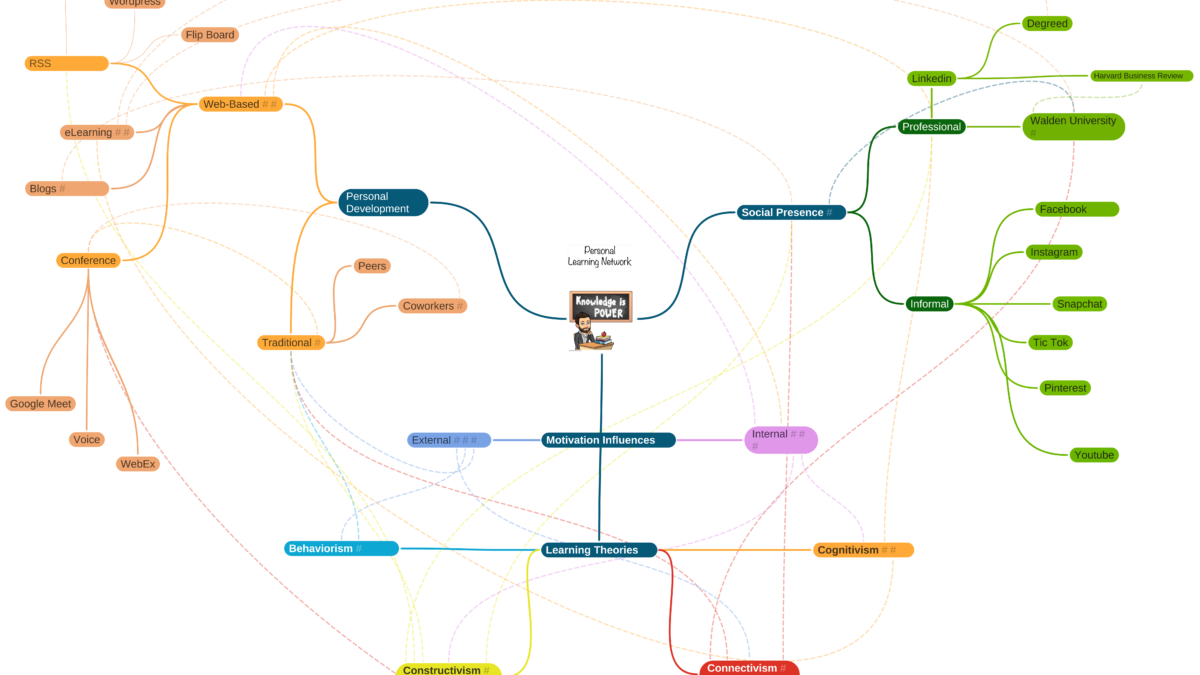
Learning Network

Personal Learning Network

In high school, the time it took to complete a course was a drawn-out perception. Motivation, extrinsically influenced, relies on a facilitator’s role in direct information processing (Cercone, 2008). As a student, I was more internally motivated to get to the next summer/holiday break. The days went by slow, and the ability to cognitively process knowledge limited by forced engagement resulting in generalized storage of the experience. As we age, the perception of time shortens. “Where has all the time gone” a frequently used saying that directly correlates with this belief. As an adult learner, the processing time for knowledge is shortened; As we have little “time” to commit to the learning process and ability to infer internal and external experiences to reduce overwriting previous LTE storage (Cercone, 2008). Knowledge facilitation evolves to become quick, direct factual information that requires self-direction (Conlan, Grabowski & Smith, 2003). The rise of technology allowed advancements in multi-media facilitation in a virtual environment built to expand one’s learning network. 

Personal Learning Networks (PLN), challenge learning interpretations by engaging in a social presence, both physical and virtual. Connectivism, theorized by George Siemens in 2005, hypothesizes continuous learning using personal informational structures is most effective when looking beyond the traditional settings to support an advanced level of understanding (Andriotis, 2017). Developing a network of learning requires a PLN comprising three elements: connection building, connection maintenance, and connection activation (Gutierrez, 2016). As these three components express similarities in personal learning environments (PLE), PLN is rooted in self-directed learners (Gutierrez, 2016). PLNs focus on adding new people or resources, keeping resources fresh, and activating these connections in the relevant context (Gutierrez, 2016). As demonstrated in many different attempts to solve how learning occurs, a PLN is only a portion of one’s PLE. One’s PLE can be comprised of like-minded peers. However, a PLN requires unique constructivist views that challenge fundamental understandings using active engagement through technological advancements in social and educational platforms (Gutierrez, 2016). In summary, PLNs are self-constructed extensions of one’s PLE (Andriotis, 2017).

The time constraints and changing demands, professional and personal, on an adult learner help define the need for a PLN, especially in the workplace. To address sustainability, and relevant both an employer and employee must develop a learning-centric culture starting with one-on-one interaction. As job expectations advance form generalized stimulus-response, cognitive processing is required to remain at the forefront of learning initiatives. The need for “expert” learning is crucial to stay innovative. PLNs answer concerns with implicating traditional learning approaches in adult learning. Formal education can negatively impact the ability to juggle “life,” the time spent constructing interpretation, and financial obligations (Andriotis, 2017).  

When reflecting on your PLN, you need to understand the benefits. PLNs are self-directed/self-constructed. They offer the learners a choice in what they learn and the resources that create active engagement in the learning process, personalizing the learning experience (Lynch, 2017). Formal and informal resources allow insight from multiple backgrounds and or experience, levels of understanding, technological facilitation methods, i.e., blogs, scholarly articles, discussions, social networks, and internal knowledge reflection (Gutierrez, 2016).  

Final Thoughts:

If the ability to absorb knowledge is infinite, only confined by how the brain processes, store, and retrieves knowledge, can a personal learning network be infinite?

Resources:

Andriotis, N. (2017, October 23). Why and how to create successful personal learning networks. TalentLMS Blog. Retrieved June 8, 2020, from https://www.talentlms.com/blog/why-and-how-to-create-a-personal-learning-network-in-the-workplace/

Cercone, K. (2008). Characteristics of adult learners with implications for online learning design. AACE Journal, 16(2), 137–159. Retrieved from http://www.editlib.org/index.cfm?fuseaction=Reader.ViewAbstract&paper_id=24286

Conlan, J., Grabowski, S., & Smith, K. (2003). Adult learning. In M Orey (Ed.), Emerging perspectives on learning, teaching and technology. Retrieved from http://textbookequity.org/Textbooks/Orey_Emergin_Perspectives_Learning.pdf

Gutierrez, K. (2016, June 21). What are personal learning networks? SH!FT eLearning. Retrieved June 8, 2020, from https://www.shiftelearning.com/blog/personal-learning-networks

Lynch, M. (2017, August 3). What is the importance of a personal learning network? The Edvocate. Retrieved June 8, 2020, from https://www.theedadvocate.org/importance-personal-learning-network/

ANDRAGogY: Adult Learning

There are many times we look to relate knowledge we have previously learned to current information presented. I consider this a way for adults to reassure confidence in prior knowledge is still relevant. Previous theories and psychological evaluations of the acquisition of knowledge, and retrieval of knowledge, approach learning as a stimulus-response through a learner’s physical or mental capabilities. Still, these options do not explicitly consider emerging technology implications on an adult’s perception of time. The time needed to process, organize, store, and recall information has decreased, allowing learners to synthesize material and build a more profound understanding in a short time frame (Cercone, 2008). The unique approach to understanding adult learners’ needs and motivation is called andragogy (Conlan, Grabowski & Smith, 2003). Andragogy uses five assumptions to facilitate adult learning effectively (Cercone, 2008). Adult learners are self-directed, internally motivated, problem-centered as it relates to current social roles, and rich in life experiences (Conlan et al, 2003).

Adult learners are often self-directed learners; however, that does not imply facilitation or environmental influences are not needed for absorption. Research has concluded the importance of social interaction as knowledge is presented. Only allowing self-directed learners in one specific environment would not allow the adequate communication needed for the deeper, or expert level of understanding. In expertise theories, adults process information quickly, analyze problems and mistakes more efficiently than novices (Conlan et al, 2003). Experts are assumed after repeated findings maintain and excel learning in their domain (Conlan et al, 2003). In my opinion, expert learners and novice learners can facilitate a better understanding. Novice learners can give different interpreted beliefs that expert levels can explore, thus maximizing both individual’s capacity for learning. However, I feel there is a point in education and or training where a self-directed learning environment would benefit expert level learners, such as a thesis or high-level management training. In these types of situations, the cognitive processing ability is more advanced and requires the application of knowledge concepts in a reflective “self-narrative” where there is no right or wrong.

The best way to reduce juggling “life” and adult education, in my opinion, is the use of online eLearning platforms. Adults are often tight scheduled, and making additional time to continue education is hard. Online learning offers facilitated direction with little face-to-face instruction, opening the pathway for self-driven learning but, more importantly, the internal identification of motivation triggers (Cercone, 2008).

In my opinion, adult learners do cognitively process information the same as children do. If there were no similarities between the two, we would not be able to apply multiple theories to each side. The critical differentiator is going to be in the response. Children are not going to have as many prior experiences to push the organization of memory effectively. In my interpretation of Dr. Anthony Artino’s post concerning the differences in training and education, learning in a child could be referred to as “training” centered education. Responses are often processed as new knowledge, or with little prior situational experience. Adult learners are pushed more into an “educational” centered approach where individuals construct answers to complex problems by applying previous experiences to further cognitive abilities (Artino, 2020). As children, most information learned will be challenged or relevant in future situations generating an implied task time frame. As adult learners, a task can have flourished rapidly; however, the knowledge constructed challenge the “knows” of the presented material. 

In conclusion, In my opinion, there are two main components to consider when designing for andragogy, adult online instruction. The Learner and the means of facilitation coexist to deepen the level of education. The Learner also must be presented with clear, goal-oriented solution that relates to the corresponding social environment (Cercone, 2008)

Resources

Artino, A. (2020, June 3). Re: Education vs. Training [Comment]. Retrieved from https://class.waldenu.edu/webapps/discussionboard/do/message?action=list_messages&course_id=_16681348_1&nav=discussion_board_entry&conf_id=_3517726_1&forum_id=_7980848_1&message_id=_108663893_1

Cercone, K. (2008). Characteristics of adult learners with implications for online learning design. AACE Journal, 16(2), 137–159. Retrieved from http://www.editlib.org/index.cfm?fuseaction=Reader.ViewAbstract&paper_id=24286

Conlan, J., Grabowski, S., & Smith, K. (2003). Adult learning. In M Orey (Ed.), Emerging perspectives on learning, teaching and technology. Retrieved from http://textbookequity.org/Textbooks/Orey_Emergin_Perspectives_Learning.pdf

Foley, G. (Ed.). 2004. Dimensions of adult learning: Adult education and training in a global era. McGraw-Hill Education.

flash-port-3

Social Enviroments implications on learner

To address if the element of “social” environments, impact on learning environments is the same, you have to understand the role of social behavior and the implications on learning. Constructivism view humans construct knowledge by adapting meaning from a previous stimulus-response in the current relevant context (Jenkins, 2006). The process of knowledge is interpreted as a “personal world” or by “mind’s adaptations” that is all internally driven (Jenkins, 2006). Piaget furthered constructivist reach by describing biological readiness, life experiences, and structures that play a crucial role in self-constructing information (Jenkins, 2006). Social environments offer the transference of an individual’s prior skills or processes, allowing learners to voice their point of view and influence the organization of information.  

In my opinion, online pedagogy can offer the same “social” environment as a traditional classroom setting but hinder the ability to advance to the next level of understanding. Howard Gardner stated there are three types of learners, native, traditional, and expert, and if the misconceptions are not challenged, the level of understanding will remain the same. The zone of proximal development describes the kind of learning environment that enables effective knowledge transfer and cognitive development (Laureate Education, n.d.). In applying both approaches, one can produce an active learning environment that is conducive to both external experiences and cognitive processing (Ormrod, Schunk, & Gredler, 2009). When looking at learning strategies and styles that each _ism favors, it doesn’t hinder the ability to influence learning, just merely suggestions that favor memory storage and organization. In the Constructivist point of view, a learner can construct their understanding based on the social environment (Ormrod, Schunk, & Gredler, 2009) ; the variable to me would be the learner’s level of understanding. Instructional settings typically viewed as social offer groups, activities, feedback, and open dialogue between leaner that foster intuitive thinking. However, emerging technology now gives us the ability to see them still visually and communicate openly in realtime, creating the same atmospheric factors. To help guide instruction, facilitators must demonstrate the ability to create a social presence, or the ability of learners to project personal characteristics, experiences, and influences into a community presenting as if “real people” (Kilgore, 2016).

Resources:

Jenkins, J. (2006). Constructivism. In Encyclopedia of educational leadership and administration. Retrieved from http://knowledge.sagepub.com.ezp.waldenulibrary.org/view/edleadership/n121.xml

Kilgore, W. (2016, November 14). Social Learning in Online Environments – Humanizing Online Teaching and Learning. Retrieved May 28, 2020, from https://humanmooc.pressbooks.com/chapter/social-learning-in-online-environments/ 

Laureate Education (Producer). (n.d.). Theory of social cognitive development [Video file]. Baltimore, MD: Author.

Ormrod, J., Schunk, D., & Gredler, M. (2009). Learning theories and instruction (Laureate custom edition). New York, NY: Pearson.

blog-1

commentary on “_isms as a Filter, not a blinker”

The ability to pinpoint how learning occurs is equally complex as the brain itself. We know how the brain receives stimulus through receptors, how the brain processes related sensory triggers in different parts of the lobes, and how transmission of signals increases as the response. While learning has shown no defined link between neuroscience, the brain’s ability to react on sensory response correlates with psychology, and how the mind interprets its environment. The theorist has illustrated many different _isms: constructivism, behaviorism, cognitivism, and a modern approach connectivism (Kerr, 2007). Each theory has beneficial contributions and limitations which help evolve the next theoretical practice. Offering solutions to another’s pitfalls will not always answer how the human brain processes information (Kapp, 2007).

In response, I agree with Kerr’s statement, “_isms are important but use them as a filter, not a blinker” (Kerr, 2007). Using one approach to facilitate learning would pose challenges when recalling information due to the limited relatable situational context needed to organize LTM effectively (Ormrod, Schunk, & Gredler, 2009). Down’s conceptualized the popular behaviorist stimulus and response approach in an analogy of a Los Vegas slot machine about Kerr’s explanation of _isms compared to a nuclear explosion disaster plan. Physically placing the coin into the slot, pulling down the handle, hearing the sounds, seeing the lights, and awareness of the environmental surroundings all play an essential factor in the appeal of the game leading players to try again. When presented with the opportunity to play a slot machine in a similar casino, the player will recall relevant situational knowledge from prior experiences and emotions, leading them to play again (Downs, 2017). Removing the flashing lights and fun sounds will not prevent spending money to play again; however, it removes sensory triggers leaving players with a less emotional connection with the game (Ormrod, Schunk, & Gredler, 2009). In Kerr’s analogy, a nuclear meltdown alert should have a list of procedures when combined with cognitivism that prevents us from being a machine (Kerr, 2007). If we used only situational influences around learning, we wouldn’t have a developed action plan because the stimuli have yet to be presented, just as a player wouldn’t typically sit at a slot machine only to feed it coins. Appling _isms as a filter would allow instructors to apply generalized concepts for information processing, and enable tailoring options to remove unimpactful methods.

Resources

Downes, S. (2017, January 1). Design: Behaviorism Has Its Place Commentary by Stephen Downes. Retrieved May 20, 2020, from https://www.downes.ca/cgi-bin/page.cgi?post=37333

Kapp, K. (2007, January 2). Out and About: Discussion on Educational Schools of Thought « Karl Kapp. Retrieved May 20, 2020, from http://karlkapp.com/out-and-about-discussion-on-educational/

Kerr, B. (2007, January 1). _isms as filter, not blinker. Retrieved May 20, 2020, from http://billkerr2.blogspot.com/2007/01/isms-as-filter-not-blinker.html

Ormrod, J., Schunk, D., & Gredler, M. (2009). Learning Theories and Instruction (Laureate custom ed.). New York, NY: Pearson.

Designs that Unclog Working Memory

The Organ

The human brain has an unlimited capacity for evolving knowledge. In instructional design, learners must be the center of all stages of a specific module via research, development, design, or implementation. How humans understand and process information through brain-based behavior can help deliver knowledge in ways that learners can receive, process, and store information adequately for later retrieval. While there is no direct link between neuroscience and how the brain processes information, there is excellent scientific evidence that the link has yet to be discovered (Jensen, 2008). Therefore, as facilitators of learning, it is crucial to understand how the brain, as an organ, functions (neuroscience) concerning education.

Inside the Cortex is where information processed is categorized into somatosensory (Parental lobes), visual (Occipital lobes), complex auditory (Temporal lobes), and lastly, “human” activities ( frontal lobes) (Ormrod, Schunk, & Gredler, 2009). After the Cortex’s lobes receive the information, knowledge remains in working memory until it is organized and stored for another similar stimulus. In summary, all knowledge is processed through the brain. How the brain uses perception, and relatability to organize and retrieve information can be classified as cognitive psychology backed by neuroscience. There is no direct relation between the two; however, one can’t exist without the other.

Information Overload

As outlined, the Cortex inside the brain is responsible for triggering responses to presented by stimuli, which can be presented in various fashions to the sensory receptors. Instructional designers can use neuroscience and how the brain interprets information through the effective use of sensory. Designing training plans should not over stimulate the sensory receptors in the CNS. Overwhelming the brain with the stimulus is no different than overworking your liver by consuming alcohol. Knowledge can be received and used while given a specific task, but with the more stimulus responses triggered, the less is committed organized long term memory. 

Cerbin defines working memory as the mental space where we do conscious, progressive thinking; however, that space has limited capacity (Cerbin, n.d.). This temporary storage allows cognitive information processing to manipulate storage later (Gutierrez, 2014). Think of working memory as a bucket; when full, the information is tossed or spilled. Even though the plastic material the bucket, made of is thin plastic, the design indentations of the bucket still lower the storage capacity. The working memory, “bucket,” uses part of the storage with tasks processed in an automatic method. When working memory is full, and the learner is challenged with many things to organize, overload sets in often resulting in a disengaged learner, but more importantly, the inability to recall responses.

Karla Gutierrez, SH!FT Disruptive eLearning contributor outlines how to design eLearning using working memory strategies, activities, and resources that will enhance cognitive processing skills using brain-function while not overstimulating. Working memory strategies help achieve a schema, receiving parts of the objective in smaller pieces (Ormrod, Schunk, & Gredler, 2009). To manage the information at each level of the pedagogy, activities, and resources help learners store information in an organization to easily retrieve under relatable circumstances. 

Conclusion 

All learning starts with the neuroscience of the brain. These discoveries have helped us understand how the brain receives processes and stores information. Where the brain stores, the data is contengient on the amount of working memory in use. To ensure learning is as simplistic for learners to process, instructional designers can use SH!FT’s suggested working memory strategies, activities, and resources. 


Resources

Cerbin, B. (n.d.). Working Memory as a Bottleneck in Learning – Exploring How Students Learn. Retrieved May 19, 2020, from https://sites.google.com/a/uwlax.edu/exploring-how-students-learn/working-memory-as-a-bottleneck-in-learning

Gutierrez, K. (2014, July 22). Designing eLearning to Maximize the Working Memory. Retrieved May 19, 2020, from https://www.shiftelearning.com/blog/bid/351491/Designing-eLearning-to-Maximize-the-Working-Memory

Jensen, Eric P. (2008). A Fresh Look at Brain-Based Education. Phi Delta Kappan89(6), 408–410. Retrieved from https://www.teachers.net/gazette/OCT08/jensen/

Ormrod, J., Schunk, D., & Gredler, M. (2009). Learning theories and instruction (Laureate custom edition). New York, NY: Pearson.